

Rotary Screw vs Piston Air Compressors
A reciprocating air compressor runs in bursts and rests in between. A rotary screw air compressor runs all day. Steady demand for hours at a stretch points to a rotary screw. Short bursts point to a piston machine, at a fraction of the price.
|
THE 30 SECOND ANSWER Short bursts, a few hours of real run time a day: reciprocating (piston). Steady air most of the work day: rotary screw. Under 10 HP, reciprocating usually wins on cost. Over 20 HP with steady demand, the rotary screw does. In between, run hours decide. |
Rotary Screw vs Reciprocating Air Compressors at a Glance
Reciprocating and rotary screw compressors are both positive-displacement air compressors. What separates them is the mechanism and how long each one can run.
| Reciprocating (piston) | Rotary screw | |
| How it compresses air | Pistons driven by a crankshaft, in strokes | Two meshing helical screws, turning continuously |
| Air delivery | Intermittent, fed from a tank | Continuous flow of compressed air |
| Duty cycle |
Single stage up to about 50 percent Two stage 60 to 75 percen |
100 percent, continuous |
| Typical max pressure |
About 125 to 135 PSI single stage About 175 PSI two stag |
100, 125 and 150 psi are the most common |
| Air receiver tank | Almost always required | An air receiver is required, either integrated or stand alone |
| Noise | Typically around 80 to 90 dBA | Typically around 65 to 80 dBA |
| Operating temperature | Runs hotter | Runs cooler |
| Purchase price | Lower | Higher |
| Cost per CFM at scale | Higher than roughly 20 HP | Lower than roughly 20 HP |
| Maintenance |
More frequent, mostly doable in-house | Less frequent, usually a technician on larger units |
| Operating environment | Tolerates dust and sheltered outdoor sites with proper inlet filter | Prefers clean indoor air |
| Best for | Intermittent bursts, smaller shops, higher pressure | All day demand, high CFM, low noise |
What Is a Reciprocating Air Compressor?
A reciprocating air compressor, also called a piston compressor, uses pistons driven by a crankshaft to compress air. The piston draws air into the cylinder through the intake valve and forces it out through the discharge valve into the tank. A single stage model typically tops out around 125 to 135 PSI. A two stage reciprocating air compressor compresses the air twice and reaches about 175 PSI. See our single stage vs two stage explainer.
What Is a Rotary Screw Air Compressor?
Rotary screw compressors use two meshing helical rotors turning inside a housing with an extremely small amount of space between them. Air comes in through the intake, mixes with the lubricant, spins through the screws, and the two are separated by a filter. The air goes to the system or tank; the lubricant collects in a sump and is recirculated.
Sometimes called rotary air compressors, they differ in one respect that matters: the rotors never touch, so air compression happens the entire time they turn. That gives a continuous flow of compressed air, not a pulse on every stroke.
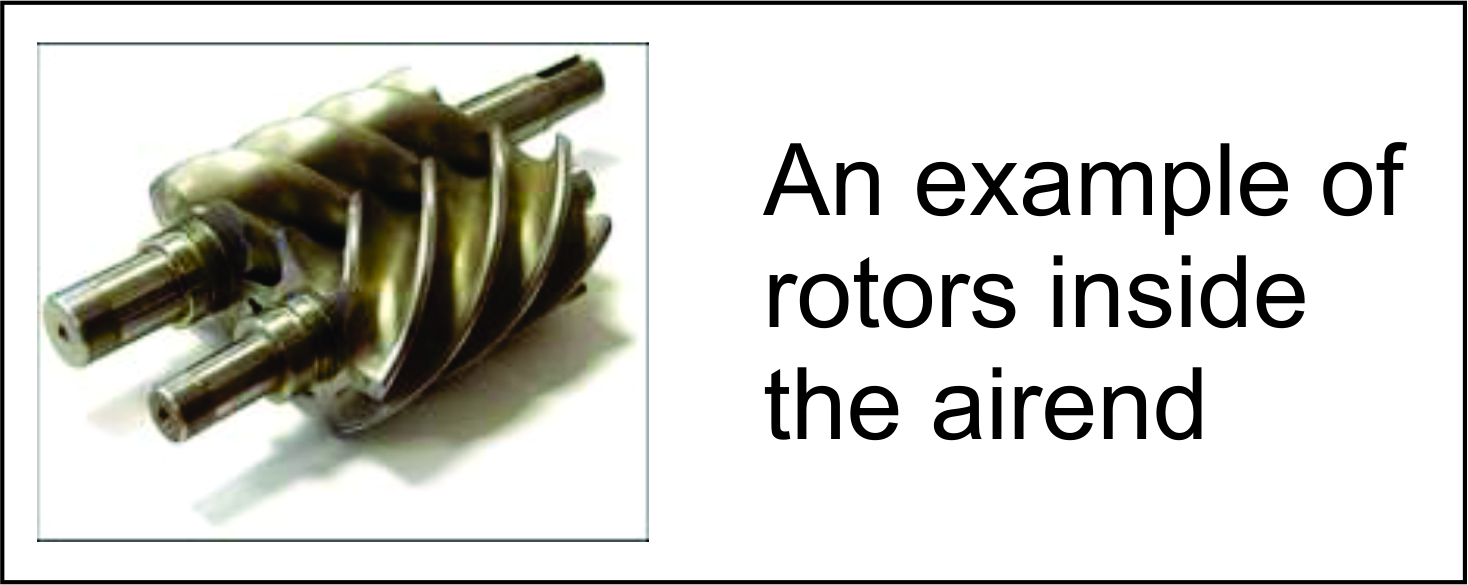

Thank you to CP Compressors for the Images
Run Time Is What Decides It
Duty cycle is the amount of time a compressor is built to run without overheating. It settles which type of compressor you need.
- Single stage piston: typically a maximum of about 50 percent.
- Two stage piston: typically 60 to 75 percent.
- Rotary screw: 100 percent, all day if the demand is there.
Worth saying plainly: some manufacturers claim 100 percent on piston machines. That is marketing, and the small print typically asks you to allow up to 30 percent for leaks and similar losses.
Rotary screws also behave differently under load. Rather than building to pressure and cutting off, most run unloaded and then load again when demand returns, saving the motor a hard start several times an hour.
Pressure, Cost, and Maintenance
Rotary screw compressors are built for air volume: they are single stage and typically produce 150 psi or less. Reciprocating compressors are built for pressure, reaching about 175 PSI on two-stage and higher on multi-stage designs, so high-pressure air is piston territory. Check your highest tool requirement first, using the chart in our compressor sizing guide.
A rotary screw also costs more up front. On energy efficiency, the two swap places as size increases: under roughly 10 HP, the lower initial cost of a piston machine wins outright, while over 20 HP with steady demand, the rotary screw delivers more CFM per horsepower. Piston machines need service more often, though a shop can do most of it in-house. Rotary screws need it less often, usually from a technician, although most have screw on filters that can be swapped easily. Where demand rises and falls through the day, a variable speed drive model may cut energy use further.
The Mistake That Ruins Rotary Screw Compressors
Oversizing a rotary screw is worse than undersizing it.
This is the one that costs people the most money. Rotary screw compressors are designed to run, and running brings the lubricant up to temperature and burns off moisture mixed in with the air. A machine far larger than your demand never gets there. The moisture stays in the lubricant, that oil stops protecting the rotors and bearings, and in the worst case scenario, the air end may fail, and that is the most expensive component in the machine.
So size a rotary screw as close to your CFM demand as you can. That is the opposite of the piston rule, where you buy extra capacity deliberately. If demand swings, choose a variable speed model over a bigger fixed speed one.
Which One Should You Buy?
| Choose a reciprocating air compressor if: | Choose a rotary screw compressor if: |
| Air use is intermittent: impacts, ratchets, nailers, blow guns | Air is in steady demand most of the workday |
| Real run time is a few hours a day or less | You run continuous-draw pneumatic tools: sanders, grinders, spray guns |
| You need pressure more than volume, above 150 PSI | You need high CFM at a stable pressure |
| Purchase price is the constraint | Energy cost over the machine's life is the constraint |
| Home shops, small machine shops, one and two-bay auto shops, jobsite work | Body shops, production, industrial air compressor applications, food and beverage |
Most, but not all automotive shops are better served by a piston air compressor because impacts and other pneumatic tools used do not require continuous air flow. Body shops almost always a better fit for a rotary screw air comrpessor, because sanders and spray guns pull air continuously. Browse piston and reciprocating compressors or our full rotary screw range.
Frequently Asked Questions
Is a rotary screw better than a reciprocating one?
Not automatically. A rotary screw is better when you need air continuously for most of the workday. A reciprocating machine is better for intermittent use, for pressure up to a maximum of 175 PSI, or when purchase price matters more than running cost.
What is the main difference between rotary screw and reciprocating air compressors?
How they compress the air, and how long each keeps going. A reciprocating machine uses pistons driven by a crankshaft to compress air in strokes, so delivery is intermittent, and it needs rest time to cool. A rotary screw uses two meshing screws that compress air for as long as they turn.
Which produces higher pressure, a piston or a rotary compressor?
A piston machine. Most rotary screw models typically deliver 150 PSI or less. Two-stage piston machines reach about 175 PSI.
Can you run a rotary screw compressor without a tank?
Most rotary screw air compressor will require an air receiver so the controls work properly.
Still Not Sure Which Type You Need?
Choosing reciprocating or rotary screw comes down to one question: how many hours a day will this machine actually be making air? Send us your tool list, run pattern, and available voltage and phase, and we will tell you which type of air compressor fits, including when the cheaper one is right. Contact us here, or call or text 803-339-0445. Every compressor ships free, factory direct.