

Why Portable Rotary Screw Air Compressors Are the Right Tool for Winterizing Irrigation Systems
When the first hard freeze rolls in, any water left sitting in an irrigation system becomes a liability. Water expands as it freezes, and that expansion is more than enough to split PVC piping, crack valve bodies, shatter backflow preventers, and rupture sprinkler heads. Blowing the lines out with compressed air before winter is the standard way to prevent that damage, and for anyone doing it at scale, a portable rotary screw air compressor is the tool built for the job.
The winterization problem, in plain terms
A "blow-out" clears standing water from an irrigation system by pushing pressurized air through each zone until only air, not water, comes out of the heads. It sounds simple, and on a small residential system it can be. The complication is that irrigation blow-outs are defined by high, sustained airflow rather than high pressure. You are not trying to pop the lines with pressure. You are trying to move a large, continuous volume of air to physically push water out of long runs of pipe and dozens of sprinkler heads.
That distinction, volume versus pressure, is exactly why compressor selection matters, and why the type of compressor you choose makes such a difference.
Why airflow (CFM) matters more than pressure (PSI)
Two numbers describe what a compressor delivers: CFM (cubic feet per minute, the volume of air) and PSI (pounds per square inch, the pressure). For irrigation winterization, CFM is what does the work.
Sprinkler zones need enough continuous airflow to evacuate every head in the zone. If the compressor cannot supply enough volume, water lingers in the low spots and the job is never truly finished. Meanwhile, pressure needs to stay low. Most irrigation guidance keeps blow-out pressure well under the pressure ratings of the system components, often in the range of roughly 40 to 80 PSI depending on whether the pipe is PVC or polyethylene. Poly lines in particular are run at lower pressure to avoid heat and damage. Push too much pressure and you risk doing exactly the damage you were trying to prevent.
So the ideal winterization compressor is one that delivers high, steady CFM at a modest, controllable pressure. That profile is what separates the right tool from the wrong one.
Where the rotary screw design wins
Most homeowners picture a piston (reciprocating) air compressor: a motor drives a piston that fills a tank, the tank empties, the motor kicks back on to refill it. That stop-start cycle is fine for running a nail gun, but it is a poor match for a blow-out, where you need airflow that does not pause. A piston unit with a small tank will drain faster than it can refill, leaving you waiting on the tank to catch up while water creeps back into the lines.
A rotary screw compressor works differently. Two interlocking helical rotors compress air continuously as they turn, producing a smooth, uninterrupted stream of air rather than tank-driven bursts. That continuous-duty design is the whole point for irrigation work:
- Sustained CFM. The screw element can run continuously without the duty-cycle limits of piston compressors. For a job that involves walking an entire property zone by zone, that uninterrupted output is the difference between finishing efficiently and babysitting a recovering tank.
- Consistent low-pressure delivery. Because the airflow is steady, it is easier to hold a safe, constant blow-out pressure rather than riding pressure spikes as a tank cycles.
- Built for long run times. Rotary screw compressors are engineered to run for hours, which is exactly what a full day of winterizing multiple properties requires.
Add portability, and you have a machine you can tow or wheel from zone to zone, property to property, without being tethered to a fixed shop compressor.
Matching compressor size to the job
CompressorPros organizes its portable rotary screw lineup by airflow, which makes sizing straightforward once you know the scale of what you are winterizing. Their Portable Rotary Screw Air Compressors category is broken into four CFM tiers:
- Up to 90 CFM — probably the most used level of portable rotary screw air compressors.
- 90–115 CFM — for larger properties, whether residential or commercial.
- 185 CFM — a workhorse tier for commercial landscapes, larger grounds, and contractors servicing many properties.
- Greater than 185 CFM — for expansive systems such as sports complexes, golf courses, parks, and agricultural irrigation.
As a rule of thumb, bigger and more complex systems, long pipe runs, many zones, high sprinkler head counts, need more CFM to clear thoroughly. Undersizing means an incomplete blow-out and freeze risk; right-sizing means water actually leaves the pipes.
For contractors whose work spans irrigation and heavy construction, CompressorPros also groups rugged units together in their Irrigation and Heavy Construction Air Compressors category, which is a sensible starting point if one machine needs to pull double duty across seasons.
Brands to look at
Across the portable rotary screw and irrigation-focused categories, CompressorPros carries three brands worth knowing:
- Atlas Copco — a long-established name in industrial and portable air, appearing throughout the portable rotary screw lineup.
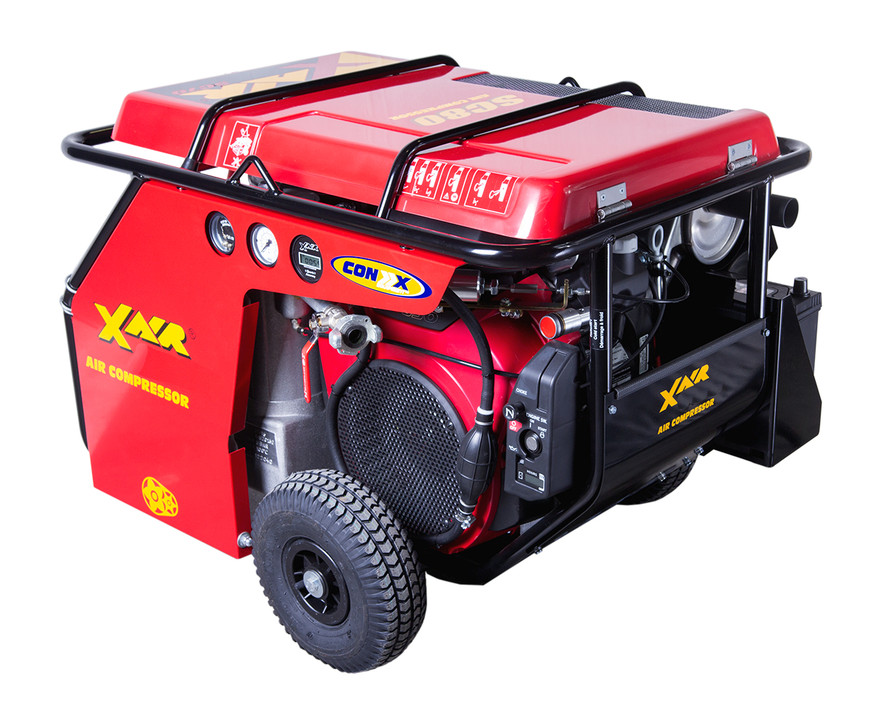
- ConX Portable Rotary Screw Compressors — a portable-focused line built specifically around this compressor style.
- Elgi — a global compressor manufacturer with several portable rotary screw options.
Look at all the options in the portable rotary screw category so you can compare within a given CFM tier.
The bottom line
Winterizing an irrigation system is fundamentally an airflow problem, and portable rotary screw compressors are the tool designed to solve airflow problems. Their continuous-duty design delivers the sustained, high-CFM, low-pressure air that clears water from lines cleanly and safely, and their portability makes them practical for contractors moving between properties and property owners handling large systems on their own.
If you're sizing a unit for this fall, start by estimating your system's scale, then match it to the appropriate CFM tier in the portable rotary screw lineup. Getting the volume right is what keeps the freeze from finding the water you left behind.