

How to Calculate Pump Up Time on Air Compressor
Pump up time is how long your compressor takes to raise the pressure in its tank from one point to another, either from zero pressure up to cut-off or from cut-in to cut-out during a normal cycle. It is worth knowing for two reasons. It tells you if the compressor is operating properly and is and easy way to know if there is an issue with your compressor or if it might be too small for the demand if you find it is not keeping up.
Use the calculator below and then use the rest of this page to understand what the number is telling you.
Open the Pump Up Time Calculator (Not Affiliated with CompressorPros LLC)
https://www.egnergy.com/calculator.html
We recommend this one because it asks for the inputs an accurate estimate actually needs, including the atmospheric pressure correction most calculators leave out. It is published by Egnergy, a compressed air efficiency engineering firm, with no signup and nothing to install. Four inputs:
- Tank volume in gallons. Stamped on the tank or listed on the data plate.
- Final pressure in PSI. Usually your cut-off setting.
- Compressor flow rating in CFM. Use delivered CFM at your working pressure, not piston displacement. This is the input people get wrong most often, and displacement ratings always read higher than what your compressor produces under pressure. This is actual delivered air.
There is a fifth, optional field for atmospheric pressure. It defaults to 14.7 PSI at sea level, and it is worth overriding if you work at elevation. The result comes back as fill time in minutes.
Two other calculators sit on the same page. The flow calculator runs the formula backwards and returns CFM from a timed pressure change, which is how you measure what your compressor is really producing. The cost calculator turns horsepower, run hours, and your electricity rate into an operating cost.
The Formula Behind It
If you want to run it yourself, this is the standard pump up time calculation:
|
Minutes = (Tank gallons x PSI change) / (110 x CFM) That is the version worth noting. The 110 is just two constants multiplied together: 7.48 gallons per cubic foot and 14.7 PSI atmospheric pressure at sea level. Written out in full it is: Pump up time (minutes) = (Tank gallons x PSI change) / (7.48 x 14.7 x CFM) |
An 80 gallon two stage compressor rated at 24 CFM, filling from empty to 175 PSI: 80 x 175 = 14,000, divided by 110 x 24 = 2,640, which gives 5.3 minutes.
The same compressor recovering from a 145 PSI cut-in to a 175 PSI cut-out: 80 x 30 = 2,400, divided by 2,640, which is about 55 seconds. That second number is the one you will actually watch all day.
Typical Calculated Pump Up Times
Four common setups, run through the formula at sea level using representative delivered CFM figures. Use them as a reference point, not a target. Your own numbers depend on tank size, delivered CFM, pressure range, and the condition of the pump.
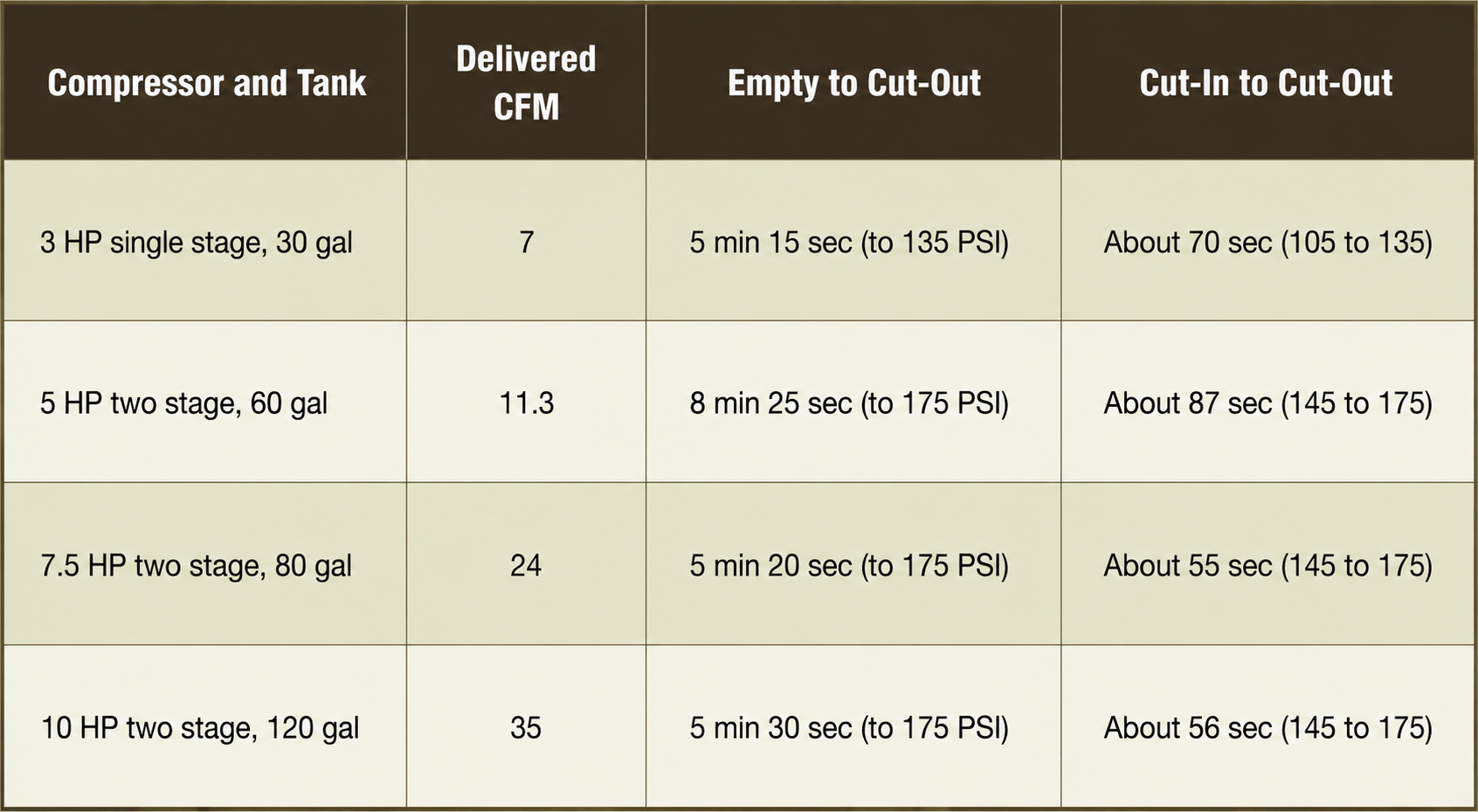
Note the 60 gallon row. A smaller pump on a large tank takes noticeably longer to fill and to recover, which is why fill speed on its own tells you very little until you know what the pump is rated for.
What to Do With the Result
Time your compressor through the same pressure range you calculated, then compare. A healthy system usually runs 10 to 20 percent slower than the math, because the formula assumes perfect conditions. If your measured time is close to the calculated time, the compressor is doing its job.
If it is well over, or if it has been creeping up month over month, work down this list roughly in order of how often it turns out to be the answer:
- Leaks. By a wide margin is the most common cause. Quick couplers, hose ends, drain valves, and regulators.
- A dirty intake filter. The cheapest fix and the one people skip. A restricted inlet starves the pump.
- Worn rings or leaking valves. Usually shows up alongside high oil consumption and a pump running hotter than it used to.
- Belt slip. A glazed or loose belt means the pump turns slower than rated, and CFM falls with it.
- Low voltage or undersized wiring. A motor fighting a voltage drop turns slower under load. See our breaker and wire size guidelines.
- A stuck unloader valve. If it vents continuously instead of only at shutdown, part of your output leaks to atmosphere every cycle.
If the pump is simply worn out, a replacement air compressor pump often costs less than a whole new unit, and filters, oil, and maintenance kits handle the routine items behind most of the slow creep in the first place.
Reverse the Calculation to Find Your Real CFM
Because you can measure tank volume, pressure, and time directly, you can solve for the one thing you cannot measure directly: how much air your compressor is actually making.
| CFM = (Tank gallons x PSI change) / (110 x minutes) |
- Drain the tank, close the drain, and shut every outlet so nothing is using air.
- Start the compressor and let it run past the cut-in pressure so the pump warms up.
- Time a 30 PSI window in the middle of the range, for example 145 to 175 PSI.
- Convert to minutes and run the formula.
An 80 gallon tank climbing 145 to 175 PSI in 80 seconds works out to 16.4 CFM. On a unit rated at 24 CFM, that is roughly a third of the output gone, and now you have a real number to use instead of wondering.
Run this test once when the compressor is new, write the result on a tag wired to the tank, and repeat it once or twice a year. Your own baseline beats any spec sheet argument, because it was measured on your machine, in your shop, at your altitude.
Why Real Pump Up Times Run Longer Than the Math
- Displacement CFM instead of delivered CFM. Displacement is what the pump produces at zero pressure. Delivered CFM is a usable number under load.
- Output falls as tank pressure climbs. The formula uses one flat CFM figure for what is really a sliding scale.
- Heat and altitude. Hot or thin air means less air mass drawn in per stroke. At 5,000 feet, expect a figure roughly 20 percent longer than at sea level.
- System volume beyond the tank. A dryer, a secondary receiver, and a few hundred feet of shop pipe all hold air. Calculations including downstream piping, etc. will not give you accurate data.
Pump Up Time FAQ
How do you calculate air compressor pump up time?
Multiply tank volume in gallons by the pressure change in PSI, then divide by 110 x the compressor CFM. The result is minutes. The 110 comes from 7.48 gallons per cubic foot multiplied by 14.7 PSI atmospheric pressure at sea level.
How long should it take an air compressor to fill up?
It depends on tank size, delivered CFM, the pressure range, and the condition of the pump, so there is no single answer. Run your own numbers through the formula or the calculator, then compare. As a reference point, a 7.5 HP two stage compressor with an 80 gallon tank and 24 CFM of delivered air calculates to a little over five minutes from empty to 175 PSI, and under a minute to recover from cut-in to cut-out.
Why is my air compressor taking so long to build pressure?
In order of likelihood: leaks in the system, a dirty intake filter, worn rings or leaking valves, belt slip, or possibly low voltage. Check for leaks before assuming the pump is at fault.
How do I use pump up time to calculate CFM?
Run the formula backwards. Isolate the tank, time how long the gauge takes to climb through a 30 PSI window, then calculate tank gallons times PSI change, divided by 110 x the time in minutes. The result is your actual delivered CFM.
Need Help Reading Your Numbers?
A slow pump up time is typically a symptom of valves or gaskets being worn out. We can always help with the calculation if you will send use the needed data: Tank Size, the Pressure Range that you Timed, The Amount of Time in Seconds it Took to Reach the Pressure.
If the compressor turns out to be undersized for the work rather than worn out, our air compressor sizing guide walks through matching CFM to your tool list, and you can shop directly by CFM once you know your number.
Call or text 803-339-0445, or email Sales@CompressorPros.com. Contact us. Every compressor we sell ships free, factory direct.