

Air Compressor Sizing Guide
Buying the wrong size air compressor is one of the most expensive mistakes you can make in a shop, and it is an easy one to make. Undersize it and your tools stall in the middle of a job. Oversize it and you have paid for horsepower and a tank you will never use.
Here is the short version. Air compressor sizes come down to four numbers: CFM (airflow), PSI (pressure), horsepower, and tank size in gallons. CFM is the one that decides whether a compressor can actually run your tools. Get the CFM right first, and everything else falls into place.
We help customers size compressors every day, and the same handful of questions come up on almost every call. This guide walks you through exactly how we answer them, so you can choose the right air compressor with confidence.
The Four Specs That Define Air Compressor Size
When people ask what size air compressor they need, they usually mean horsepower or gallons. Those matter, but they are not where you start. Four specs together define the size of any air compressor, and each does a different job.
CFM (cubic feet per minute) is the volume of air the compressor delivers. This is the number that decides whether your tools run. Every air tool has a CFM requirement, and your compressor has to meet or exceed the total.
PSI (pounds per square inch) is the amount of pressure behind that air. Most air tools want about 90 PSI at the tool, and tank pressure runs higher so you keep a reserve. CFM is always rated at a specific PSI, so the two numbers work together.
Horsepower describes the motor driving the pump. More horsepower usually means more CFM, but not always. Two compressors with the same HP can deliver very different airflow depending on pump design, so treat horsepower as a rough guide and trust the CFM rating.
Tank size, measured in gallons, is your air reservoir. A bigger tank does not add CFM. What it does is store compressed air so the motor cycles less often during short bursts of air, such as when using a nail gun or impact wrench.
If you remember one thing about air compressor size: CFM runs your tools, PSI is the pressure behind it, horsepower drives the pump, and tank size smooths out demand.
How to Figure Out What Size Air Compressor You Need
Compressor sizing is not guesswork. It is a short calculation, and it starts with your tools, not the compressor.
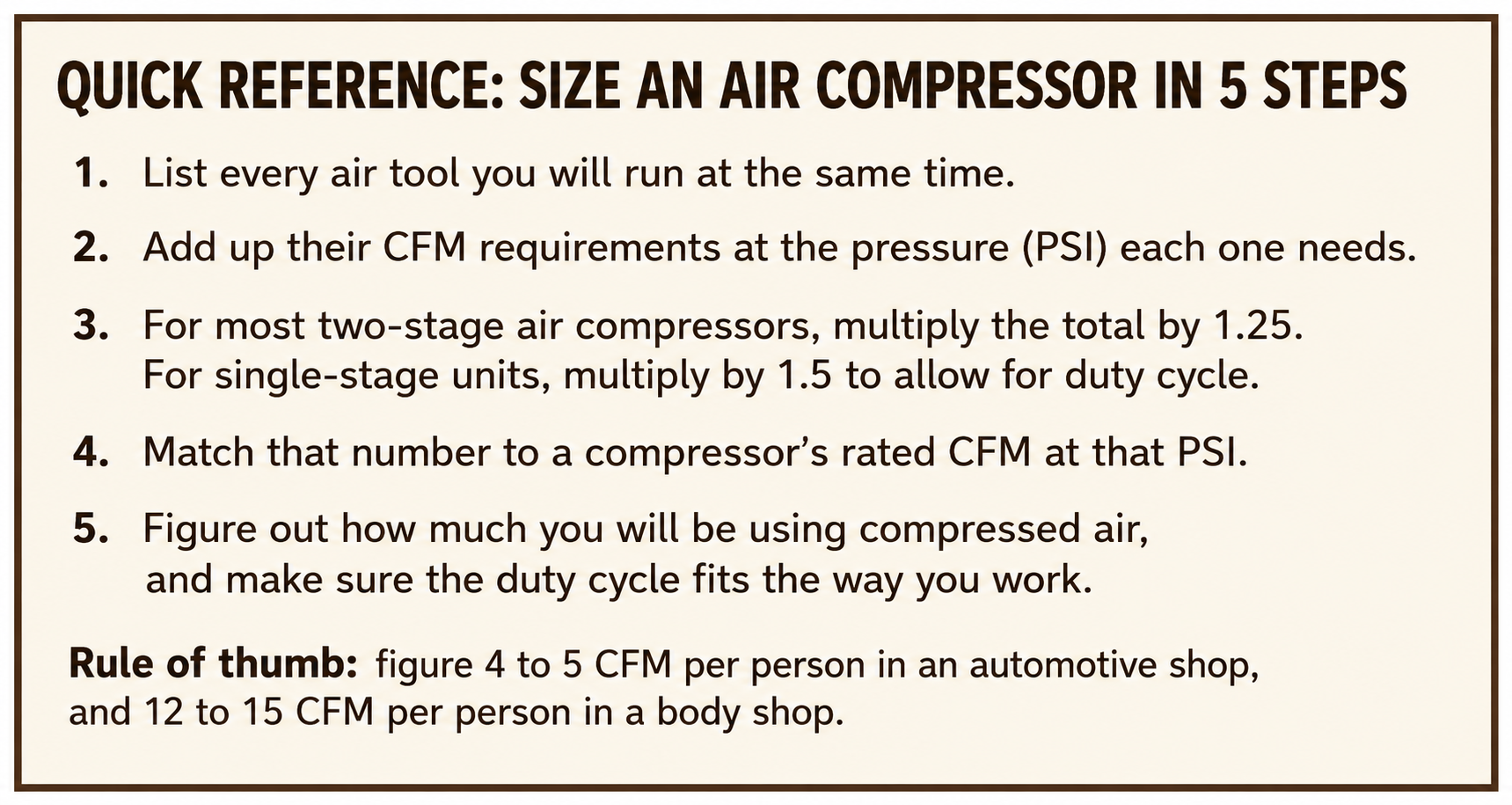
First, list every air tool you plan to run at the same time. A single mechanic rarely runs an impact wrench and a die grinder at once, but two techs sharing one compressor might. Size for simultaneous use, not just one at a time.
Next, add up the CFM requirements for those tools at their working PSI, using the air tool CFM chart below. Then take that total and add at least 25% to that total for most two-stage and at least 50% for single-stage by taking the CFM total and multiply it by 1.25 or 1.5.
Here is a real example we walk customers through. Say you have three mechanics who might all be using air at once. Three people in an automotive setting land around 12 to 15 CFM total. Multiply by 1.25 and you need roughly 15 to 19 CFM. That points you toward a 5 to 7.5 HP air compressor running at a comfortable 75 percent duty cycle. Big enough to keep up, not so big that you are consuming more energy than needed.
For a quick starting point without the math, figure 4 to 5 CFM per person in an automotive shop, and 12 to 15 CFM per person in a body shop, where sanders and spray guns pull far more air. Once you have your number, you can browse compressors by CFM to narrow down your search.
Air Tool CFM Chart
Different tools use vastly different amounts of air. These figures below are estimates and not exact figures, because there are factors in how much air a specific tool uses including how it is used and even its age because older tools may have leaks that would not be present with a new tool. Tools like sanders and grinders will consume more air because they are used nearly continuously where an impact wrench is much more intermittent.
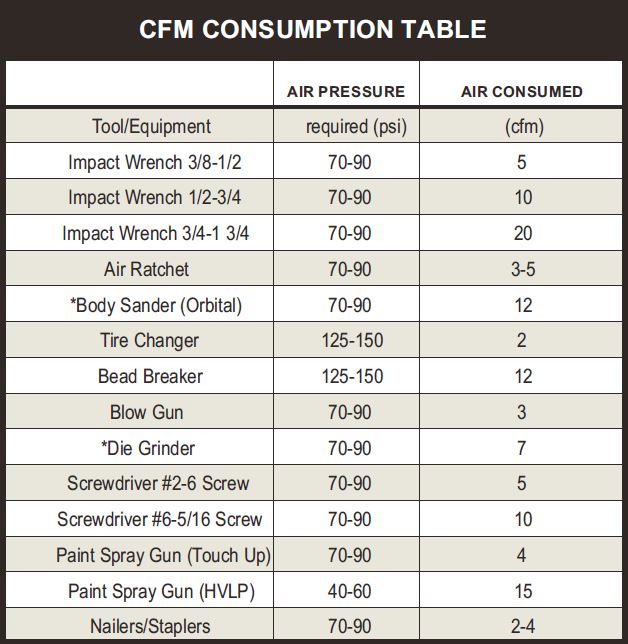
Two things are worth noting on this chart. Tire changers and bead breakers require 125 to 150 PSI, higher than everything else, so confirm your compressor can hit that pressure and not just the CFM. And an orbital body sander at 12 CFM or an HVLP gun at 15 CFM will consume enough air to demand 20 CFM by themselves.
Duty Cycle: The Spec Most Buyers Skip
Duty cycle is the percentage of time a compressor is built to run without overheating, and it is the single most overlooked number in compressor sizing.
A single stage air compressor typically has a maximum duty cycle of 50 percent or less. That means for every minute it runs, it needs about a minute to cool. So for a single stage unit, buy one that provides double your actual air demand. If you need 10 CFM of steady air, size for a unit rated around 20 CFM so it is never operating at 100 percent.
A two stage air compressor is built for heavier use, with a maximum duty cycle of 75 percent, though some two stage models are rated at 60 percent. That higher duty cycle is a big reason two stage units suit shops that run air all day.
Ignore duty cycle and even a compressor with the right CFM on paper will overheat, shut down, and wear out early.
Single-Stage vs Two-Stage Air Compressors
How many stages a compressor has just means how many times the air is compressed before reaching the tank.
A single stage air compressor compresses air once and tops out around 125 to 135 PSI. These are best suited for home garages, DIY work, and light intermittent tool use well.
A two stage air compressor compresses air twice, typically reaching 175 PSI, and moves more air with a higher duty cycle. This is the choice for busy automotive shops, body shops, and anyone running air tools for hours at a stretch.
Not sure which side of the line you fall on? Our single stage vs two stage explainer breaks down the difference in plain terms.
Portable vs Stationary: Match the Compressor to How You Work
Size is not only about airflow. The physical size and format of the compressor decide whether it fits your work at all.
Portable air compressors trade tank capacity for mobility. Within portable, the tank style tells you what it is built for:
- Pancake and hot dog compressors are small, light, and great for trim, nailing, and DIY.
- Twin-stack units carry more air for framing and punch-list work.
- Wheelbarrow compressors roll around a job site and feed one or two continuous tools.
Stationary air compressors are permanently mounted, use big vertical or horizontal tanks, and deliver the sustained CFM a shop needs. If compressed air is central to your daily work, a stationary unit almost always wins on cost per CFM and on longevity.
Power Source and Voltage: Get This Right Before You Buy
The best-sized compressor in the world is useless if you cannot power it. This is a critical element of choosing the right compressor.
Electric air compressors are the default for indoor shops: cleaner, quieter and lower maintenance. What matters is your available voltage. 115 or 230 are your standard voltages for single-phase power, while 208, 230, or 460 volts are your common voltages for three-phase. Air compressors 10 HP and above will typically require three phase power, although some exceptions exist. Be sure that you know your available voltage before purchasing.
Gas-driven air compressors exist for one reason: no available electrical power source. On open job sites and out in the field, a gas engine gives you air where electric cannot reach. Never operate a gasoline or diesel-driven air compressor indoors.
For high-demand, 100% duty operations, a rotary screw compressor is designed to produce compressed air continuously.
Oil-Free vs Oil-Lubricated
This choice affects maintenance, noise, and where you can safely use the air.
Oil-lubricated compressors run quieter, last longer under heavy use, and cost less to operate over time. The trade-off is routine oil changes and a small chance of oil carryover in the air.
Oil-free air compressors need less maintenance and deliver cleaner air, which matters for medical, dental, food, and fine finishing work where oil contamination cannot be tolerated. Depending on the technology, oil free compressors can produce more noise and have a shorter service life.
Tank Size: How Many Gallons Do You Really Need
Tank size is the most misunderstood spec. A bigger tank does not give you more CFM, and it will not fix an undersized compressor.
What a larger tank does is buffer demand. For tools that operate in short bursts, like nailers, impact wrenches, and ratchets, a big tank lets the motor rest between cycles. For tools that run continuously, like sanders and spray guns, the tank empties fast and CFM does all the work.
Rough suggestions: 6 gallons is plenty for a nailer or trim work. 20 to 30 gallons suits a home garage with occasional tool use. 60 to 80 gallons is the sweet spot for a serious automotive shop. Match tank size to your work pattern, not to a bigger-is-better instinct.
Common Air Compressor Sizing Mistakes
After years of these calls, the same errors come up again and again. Avoid these five and you will size right the first time.
- Buying on horsepower alone. HP is a marketing number as much as an engineering one, and two 5 HP compressors can deliver very different CFM. Compare CFM at PSI, every time.
- Forgetting the duty cycle.A single stage unit sized for exactly your demand will run at 100 percent and burn out, so buy double the air on single stage. A two stage runs a 60 to 75 percent duty cycle, so size it to produce at least 25 to 40 percent more air than your application actually requires.
- Sizing for one tool. Add up everything running at once, then apply at least a 25% buffer. The tool you forget is the one that starves.
- Ignoring pressure. A compressor that hits your CFM but not your PSI still fails you on a tire changer or bead breaker that wants 125 to 150 PSI.
- Chasing tank gallons instead of CFM. A huge tank with a smaller pump just takes longer to
run out, but takes longer to fill back up.
What Size Air Compressor for Common Jobs
A quick starting point by application. Always run your own tool list through the CFM math above, but this is where most buyers land.
- Home and DIY (nailing, inflating, occasional tools): 1 to 2 HP, 6 to 30 gallon, single stage.
- Auto garage (impacts, ratchets, one tech): 5 to 7.5 HP, 60-80 gallon, two stage.
- Body shop (sanders, HVLP spray): high-CFM two stage, 80 - 120 gallon, sized for continuous operation.
- Contractor and framing (portable, job site): twin-stack or wheelbarrow, or gas on open sites.
- Industrial and continuous operation: rotary screw, sized to your peak simultaneous CFM.
Frequently Asked Questions
What size air compressor do I need for air tools?
Add up the CFM of every tool you will run at once at their working PSI, then add a buffer. Multiply by 1.25 for a two stage compressor, or by 1.5 for a single stage, since a single stage runs a lower duty cycle and needs more headroom. Match that number to a compressor's rated CFM at 90 PSI. For a single tech in an auto shop, that is usually a 5 to 7.5 HP two stage unit.
Is CFM or PSI more important when sizing an air compressor?
CFM decides whether your tools run at all, so start there. PSI still matters, because a few tools like tire changers need 125 to 150 PSI. Size for CFM first, then confirm the compressor reaches the highest PSI any of your tools require.
How much CFM do I need for a home garage?
Most home garages run fine on 4 to 6 CFM, enough for small impact wrenches, ratchets, blow guns, and inflating. Continuous-use tools like sanders push that number higher, so if you plan to paint or sand, size for those tools specifically.
Does a bigger tank mean more air?
No. Tank size stores air, it does not increase CFM. A bigger tank helps with short-burst tools by letting the motor rest between draws, but for continuous tools, CFM is what counts.
What size air compressor do I need to paint a car?
HVLP spray guns pull around 15 CFM at 40 to 60 PSI and run continuously, so you need real airflow. When considering duty cycle, plan on using a compressor that can produce at least 20 CFM, which would be on the very top end of 5 HP, but typically would be in the 7.5 HP range.
Single stage or two stage for an auto shop?
Two stage. It reaches higher pressure, around 175 PSI, and carries a a 60 to 75 percent duty cycle, so it keeps up with all-day tool use. Single stage suits lighter, intermittent home and DIY work.
Still Not Sure What Size You Need?
Sizing a compressor for a whole shop involves more than a chart, and the cost of guessing wrong is high. Send us your tool list and your available power, and we will assist finding you the best fit.
Call or text 803-339-0445 or email Sales@CompressorPros.com. Every compressor we sell ships free, factory direct. Once you know how much CFM you require, browse compressors by CFM or explore portable and stationary models to find the exact fit.